The lesson
English uses -ing after words like after, without and for: after eating, without saying a word, thanks for coming. Italian uses an infinitive after prepositions, and when the action is already finished, it uses the infinito passato, the past infinitive: dopo aver mangiato, *grazie per essere venuti*.
There’s little new to learn. It’s avere or essere plus the past participle, with the same choice of auxiliary and the same agreement as the passato prossimo. The skill is knowing where it goes: after dopo, after per for a reason, after senza and in thanks and apologies, but not after prima di.
Building it: aver or essere + participle
Take the infinitive of the auxiliary and add the past participle: aver mangiato, aver fatto, aver visto, essere partito, essere venuto. Choose the auxiliary exactly as in the passato prossimo: ho mangiato → aver mangiato, sono partito → essere partito.
The past infinitive doesn’t change for the person: dopo aver mangiato works for io, tu, lei or loro. With essere, though, the participle agrees with the subject: Giulia, dopo essere partita, *i ragazzi, dopo essere partiti*.
Aver and avere are both correct. Italians usually drop the final -e: dopo aver mangiato sounds more natural than dopo avere mangiato. You’ll also see esser for essere in writing.
| passato prossimo | past infinitive |
|---|---|
| ho mangiato | aver mangiato |
| ho fatto | aver fatto |
| sono partita | essere partita |
| siamo tornati | essere tornati |
Reflexive verbs
Reflexive verbs take essere, and the reflexive pronoun is joined to the end of it: essermi, esserti, essersi, esserci, esservi, essersi. The pronoun matches the subject, and the participle agrees.
So a woman says Dopo essermi alzata, faccio la doccia, and a group of friends says Dopo esserci vestiti, siamo usciti.
Never avermi alzato: reflexive means essere, every time.
Dopo and prima di
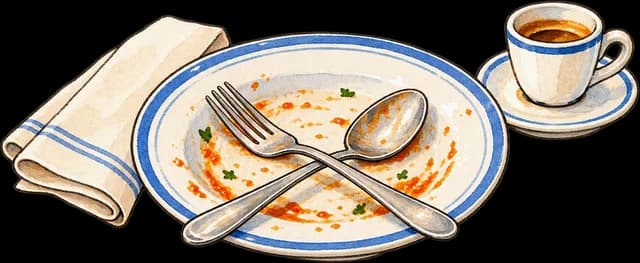
Dopo + past infinitive says the first action is finished before the second: Dopo aver visto il film, siamo andati a cena. English can say after seeing, but Italian needs the past form. Dopo mangiare is heard in casual speech, but dopo aver mangiato is the standard.
Prima di + plain infinitive: the action hasn’t happened yet, so there’s no aver or essere. Prima di uscire, spengo le luci. Don’t forget the di.
Same subject only
Dopo + infinitive only works when the same person does both things. Dopo essere partito, ho pulito la casa means I left and I cleaned.
When the subjects are different, use dopo che + passato prossimo: Dopo che sei partito, ho pulito la casa (you left, I cleaned).
Senza and per
Senza + infinitive means without doing: È uscita senza prendere l’ombrello. Use senza aver + participle to stress that something hadn’t happened first: Ha passato l’esame senza aver studiato molto.
Per + past infinitive gives the reason, for having done: Il vigile ha multato Paolo per aver parcheggiato male. Watch out: per + present infinitive means in order to. Per parcheggiare = to park.
Thanks, apologies and memories
Many everyday phrases look back on something done: grazie per, scusa per, mi dispiace di, sono contento di, ricordo di. Add the past infinitive: Grazie per essere venuti!, Mi dispiace di non essere venuto alla tua festa.
Non goes right before aver or essere: mi dispiace di non aver chiamato.
Pronouns on the end
Object and reflexive pronouns join the end of aver or essere, as one word: averlo, averla, averle, avermi, averti. Never in front: dopo lo aver visto is wrong.
As in the passato prossimo, the participle agrees after lo, la, li, le: La lettera? Dopo averla letta… With indirect pronouns (le = to her, gli = to him) there’s no agreement: dopo averle parlato.
Common mistakes
- Dopo ho mangiato, sono uscito.Dopo aver mangiato, sono uscito.After a preposition, Italian uses an infinitive, not a conjugated verb.
- Dopo aver partito, ho chiamato.Dopo essere partito, ho chiamato.Partire takes essere, as in sono partito.
- Prima di essere uscito, ho chiuso la porta.Prima di uscire, ho chiuso la porta.Prima di takes the plain infinitive.
- È uscito senza dicendo niente.È uscito senza dire niente.After senza, the infinitive, never the gerund.
- Dopo avermi alzato, ho fatto colazione.Dopo essermi alzato, ho fatto colazione.Reflexive verbs take essere.
- La lettera? Dopo la aver letta…La lettera? Dopo averla letta…The pronoun joins the end of aver.
The full pattern
Aver(e) or essere + past participle. Same auxiliary and agreement as the passato prossimo.
| with avere | aver mangiato · aver fatto · aver visto |
| with essere | essere partito/a/i/e · essere venuto/a/i/e |
| reflexive | essermi alzato/a · esserti · essersi · esserci · esservi · essersi |
| after | dopo + past infinitive: dopo aver mangiato |
| before | prima di + plain infinitive: prima di uscire |
| without | senza dire · senza aver detto |
| reason | per aver parcheggiato male · grazie per essere venuti |
| pronouns | dopo averlo visto · dopo averla vista · dopo averle parlato |
Same subject only: dopo essere partito (I left); dopo che sei partito (you left).
Aver and avere are both right; aver is more common.
Prima di never takes aver or essere: prima di uscire.
In short
- Past infinitive: aver + participle or essere + participle (agreeing): aver mangiato, essere partita, essermi alzato.
- Dopo + past infinitive, same subject only; otherwise dopo che + passato prossimo. Prima di + plain infinitive.
- Senza (aver) + infinitive; per + past infinitive for the reason; grazie per, mi dispiace di + past infinitive.
- Pronouns join aver: averla vista, averle parlato.